
Digital Repertoires: How Older Adults Really Use Technology
edited by Rita Hanninen, Sakari Taipale and Laura Haapio-Kirk
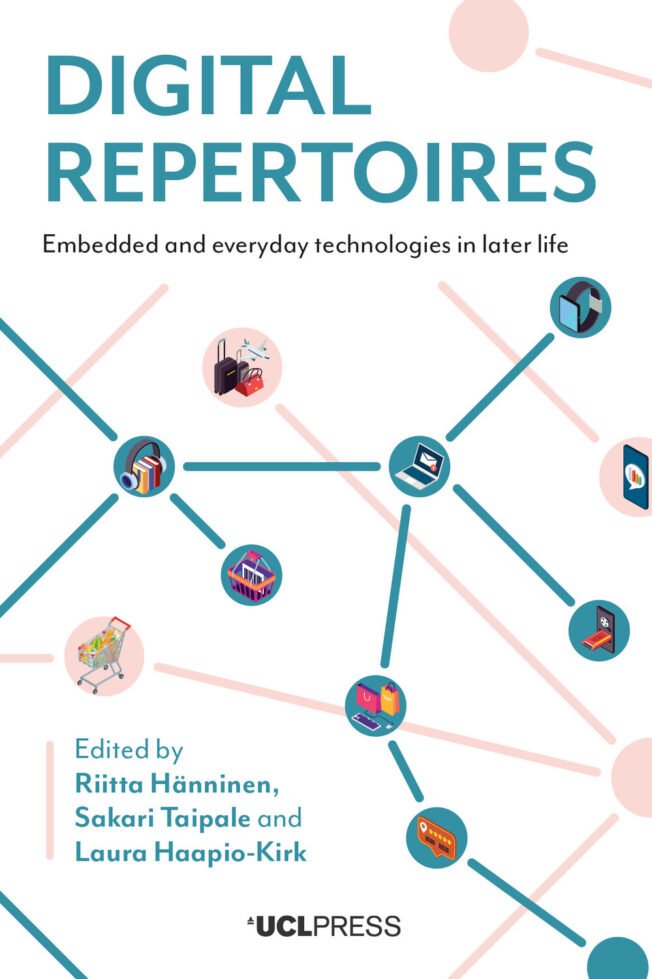
What is this book about ?
DIGITAL REPERTOIRES explores how older adults actually use digital technologies in their everyday lives. Instead of asking whether older people have enough “digital skills” or access to the latest devices, the book looks at the practical, creative, and often invisible ways people fit technology into their daily routines as they age. The authors call this collection of habits, strategies, tools, and social supports a person’s “digital repertoire”.
Why is this important ?
Our public discussions about technology and aging often frame older adults as “behind,” “excluded,” or lacking skills. This book challenges that presumption. It argues that most older adults are not simply users or non-users of technology. The they actively make choices about what technologies matter to them, how they use them, and when they avoid them. These choices are shaped by culture, health, family relationships, resources, and personal values…not just age.
What is a “digital repertoire” ?
A digital repertoire is the mix of devices (like smartphones or computers), apps, habits, workarounds, and people that someone relies on to get things done. For example, an older person might text family on WhatsApp, use a phone instead of an online form to book an appointment, ask a friend for help with a new app, or combine digital and non-digital methods to stay connected. All of this together…not just technical skill...makes up their digital life.
How does the book make its argument ?
Through real-world studies in countries such as Finland, Japan, Australia, and Brazil, the book shows that:
Older adults use technology in deeply personal and meaningful ways, often focused on communication, care, and wellbeing.
Family members, friends, and informal helpers (“warm experts”) are often more important than formal training.
Cultural norms strongly influence how technology is used (for example, visual messaging in Japan or social networks in Brazil).
People are creative: they adapt technologies, invent workarounds, and combine old and new tools to suit their needs.
Digital inclusion is not just about teaching skills, but about respecting different ways of living and aging.
Are the arguments made important for seniors ?
The book argues that governments, universities, designers, and service providers often assume everyone uses technology the same way. This leads to systems that exclude many people. By understanding digital repertoires, institutions can design technologies and services that are more inclusive, flexible, and humane—not only for older adults, but for everyone.
The big idea to take away
Everyone has a digital repertoire, and it changes over time. Aging does not mean technological decline. Instead, it highlights the importance of designing digital systems (and therefore relationships) that work with real lives, real relationships, and real human needs. We are invited by the book to rethink what “digital competence” really means…and to imagine more age-friendly digital futures.
~ G.L. Wallace ( Co-Founder )
Note: This is not a paid sponsorship. Seraphim Foundation for Aging (SFFA) has not receive compensation for publishing this review.